Forex trading duniya ka sab se bara financial market hai jahan currencies ki buying aur selling hoti hai. Har din trillion dollars ka trading volume hota hai. Bohat se log online forex trading ke zariye income generate karna chahte hain, lekin beginners ko market ki proper understanding zaroori hoti hai. Forex trading high-risk bhi ho sakti hai, is liye knowledge aur strategy bohat important hai.
What is Forex Trading?
Forex ka matlab Foreign Exchange Market hai jahan currencies trade hoti hain, jaise:
EUR/USD
GBP/USD
USD/JPY
Traders currency pairs ko buy ya sell karte hain aur price movement se profit lene ki koshish karte hain.
How Forex Trading Works
Forex market 24 hours open rehta hai aur duniya ke different financial centers me operate karta hai. Trading brokers ke through hoti hai aur traders platforms jaise MetaTrader use karte hain.
Basic process:
Broker account open karna
Trading platform install karna
Currency pair select karna
Buy ya Sell trade open karna
Profit ya loss close karna
Benefits of Forex Trading
Forex trading ke kuch advantages bhi hain:
24/5 market availability
High liquidity
Small investment se start
Online access from anywhere
Lekin is me risk bhi zyada hota hai, is liye traders ko risk management use karna chahiye.
Chart Patterns Every Forex Beginner Should Know
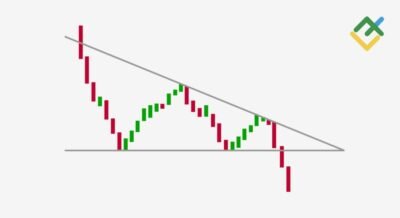
Price charts often form recognizable patterns that traders use to anticipate future moves. The descending triangle is a bearish continuation pattern formed by a flat support line and a falling resistance line.
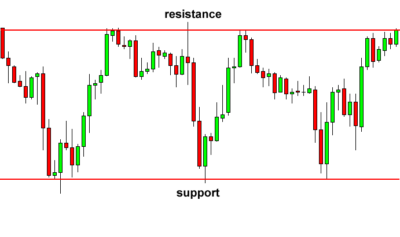
The rectangle chart pattern shows the price consolidating between two horizontal support and resistance levels before an eventual breakout.
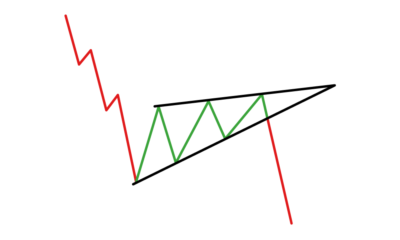
The rising wedge pattern is a bearish reversal formation created by two upward-sloping, converging trendlines.
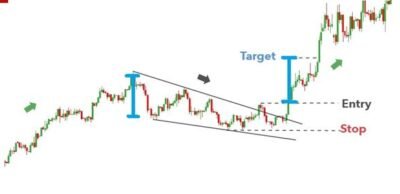
The falling wedge pattern is the bullish counterpart, formed by two downward-sloping, converging trendlines.
The ascending triangle pattern is a bullish continuation formation with a flat resistance line on top and a rising support line underneath.
The head and shoulders pattern is a three-peak reversal signal that commonly forms at the top of an uptrend.
The cup and handle pattern is a bullish continuation setup built from a rounded, U-shaped recovery followed by a smaller pullback.
The bull flag and bear flag pattern is a short-term continuation setup formed by a sharp move followed by a tight, sloped pause before the trend resumes.
The symmetrical triangle pattern forms when a falling resistance line and a rising support line converge, signalling a breakout in either direction once price reaches the apex.
The double top and double bottom pattern is a classic reversal signal that appears after price fails twice to break through a key support or resistance level.
The triple top and triple bottom pattern is a stronger reversal variant, forming when price tests the same support or resistance level three times before turning.
The rounding bottom (saucer) pattern is a gradual bullish reversal that develops as selling pressure fades and buyers slowly regain control.
Risks in Forex Trading
Forex trading me profit ke sath loss ka risk bhi hota hai. Beginners aksar bina knowledge ke trading start kar dete hain jisse capital loss ho sakta hai.
Common risks:
High leverage
Market volatility
Emotional trading
Lack of strategy
Tips for Beginner Traders
Agar aap forex trading start karna chahte hain to ye tips follow karein:
Demo account se practice karein
Risk management use karein
Reliable broker choose karein
News aur market analysis follow karein
Over-trading se bachein